Tell us about the job
Takes about a minute. No obligation.
A contractor quoting a central AC repair in Des Moines County has to work out what the system has already been through before they can say which part failed and what fixing it costs. 146 severe weather events were recorded in Des Moines County, Iowa between 2015 and 2024. At that rate, severe weather is a standing operating condition here, not an occasional one, and the compressor, capacitors, and contactors in a system that has been running against that load carry wear that reflects it. A refrigerant leak or a seized contactor in this county is as likely to trace back to cumulative stress as to any single event, and a good diagnosis prices that history in.
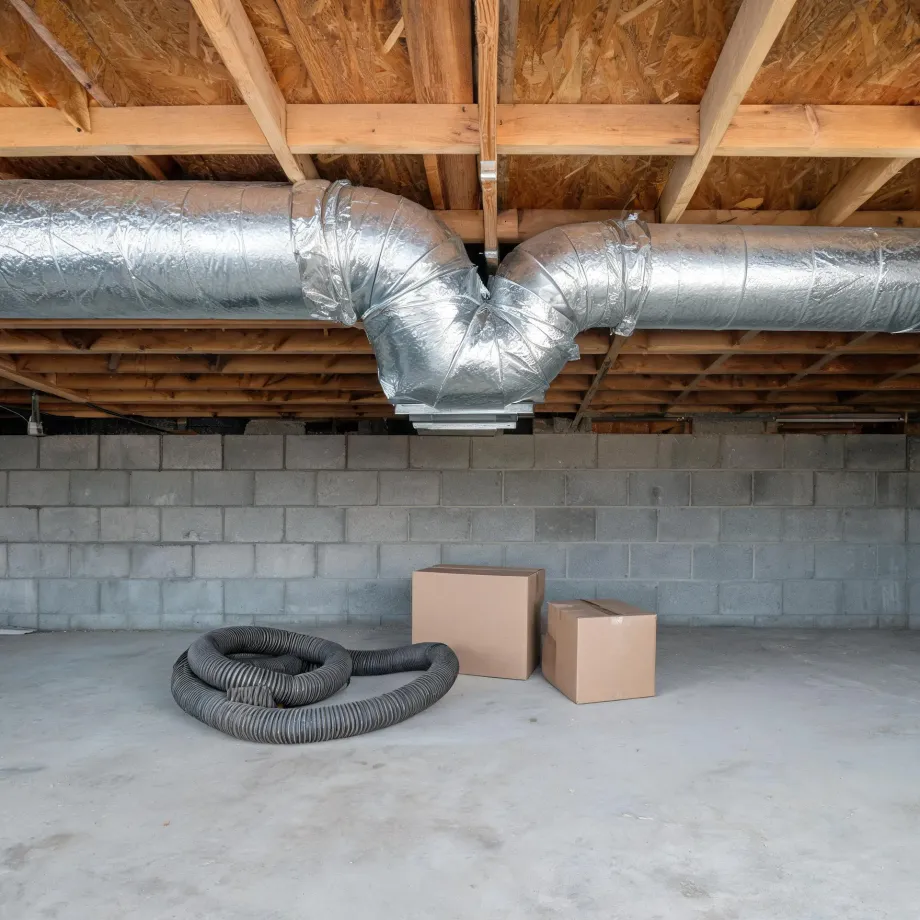
Ductwork in a house this old has been patched, re-routed, or left as-is through multiple equipment generations, so by the time a system needs repair, the ductwork is a given and the opened unit is the question. Half the homes in Des Moines County, Iowa were built in 1959 or earlier (2020-2024 ACS 5-year). Equipment installed into stock that age has cycled through more than one replacement, and the parts a current system requires may sit at the edge of what suppliers still stock. A contractor working a repair here checks availability before committing to a scope, because a part that looks standard on a spec sheet can be discontinued or on a long lead time when the order actually goes in.
The Parts of a Central AC a Contractor Checks First
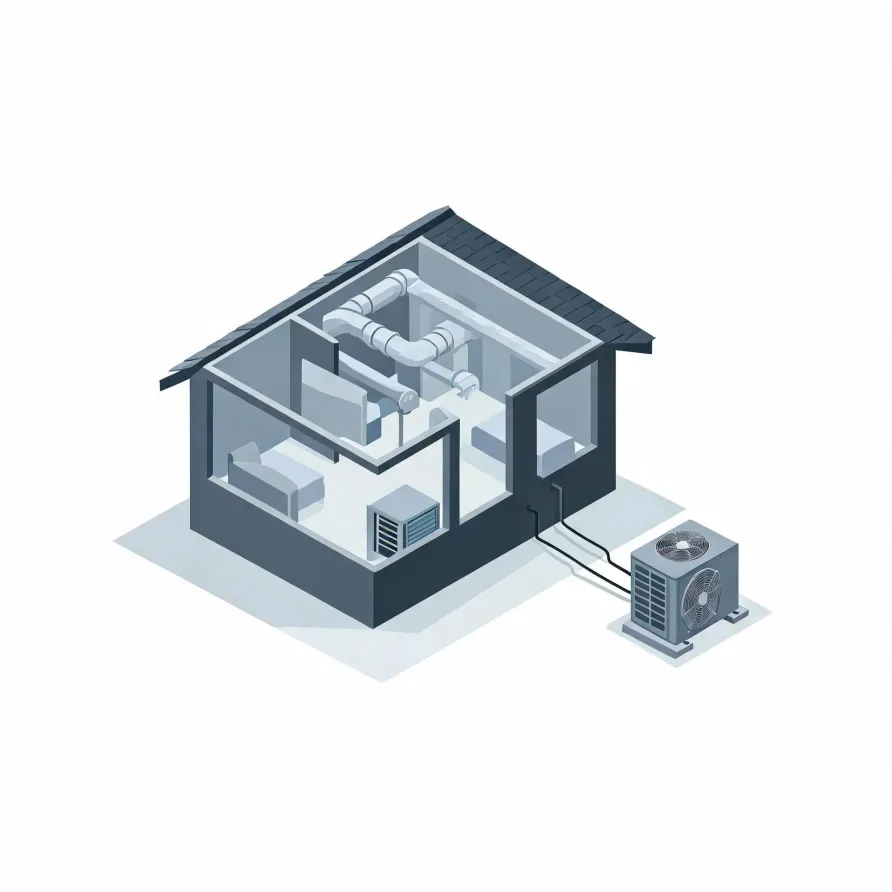
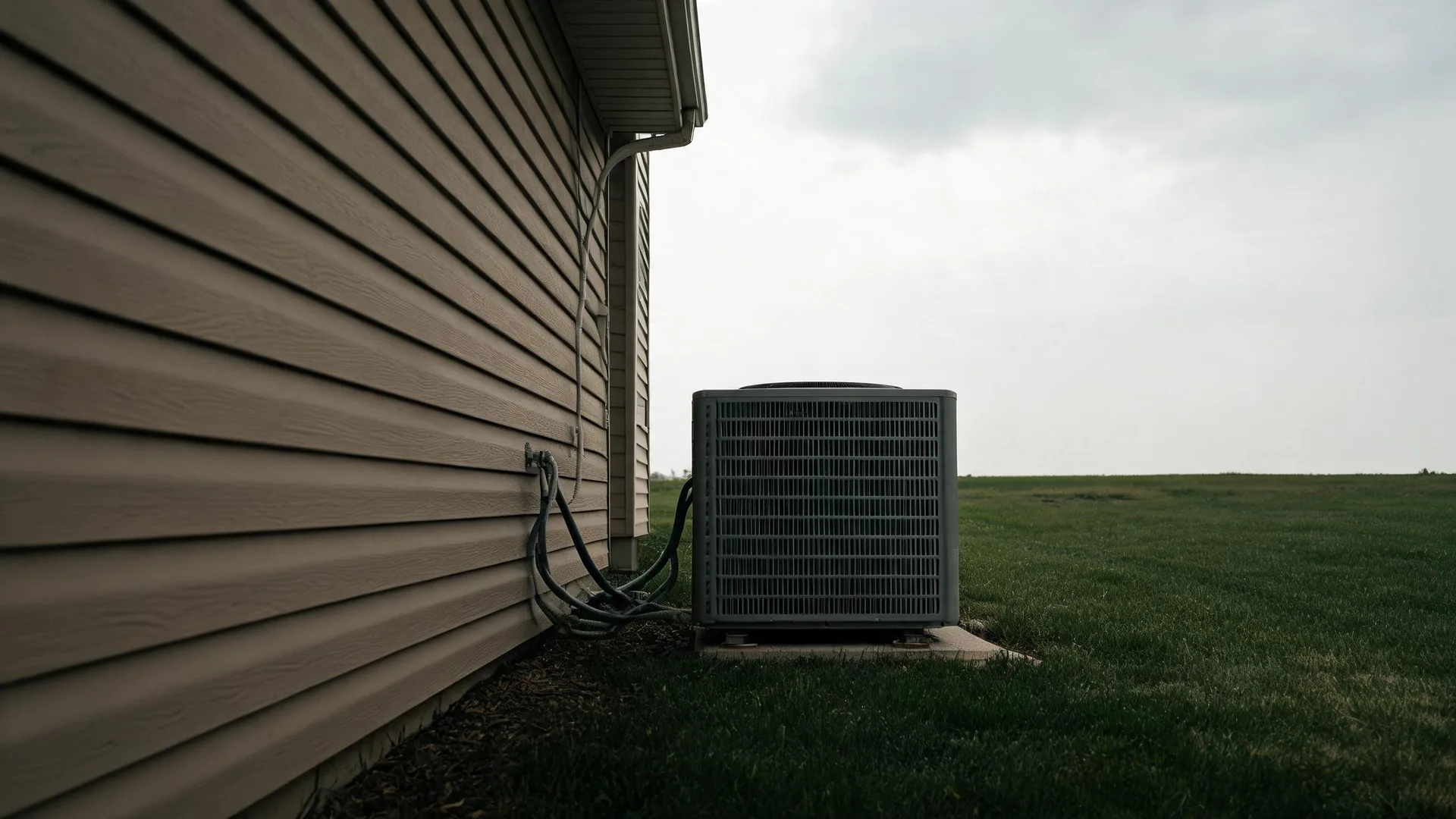
The outdoor condenser unit sits on a pad outside the house and holds the compressor and condenser coil, the two components a contractor reaches for first when the system stops cooling. The compressor is the heart of the circuit; when it fails, nothing else in the system can compensate. The condenser coil sheds heat to the outside air, and a dirty or damaged coil is one of the more common reasons a system runs but cannot keep up.
Inside the house, the air handler houses the evaporator coil and the blower. The evaporator coil pulls heat out of the air moving across it, and a refrigerant leak or a frozen coil points a contractor straight to this component. The blower pushes conditioned air through the house, and a failed motor or a clogged filter will show up as weak airflow long before anything else gives out.
The drawing shows a typical layout, and a licensed contractor determines which components apply to your specific system and what work each one needs.
Get matched in Des Moines CountyDes Moines County, by the numbers
146 severe weather events were recorded in Des Moines County, Iowa between 2015 and 2024.
NOAA National Centers for Environmental Information, Storm Events Database, bulk CSV export, events 2015-01-01 through 2024-12-31.Half the homes in Des Moines County, Iowa were built in 1959 or earlier (2020-2024 ACS 5-year).
U.S. Census Bureau, 2020-2024 American Community Survey 5-Year EstimatesDes Moines County, Iowa holds 18,802 housing units (2020-2024 ACS 5-year).
U.S. Census Bureau, 2020-2024 American Community Survey 5-Year EstimatesOwners occupy 74.6% of the occupied homes in Des Moines County, Iowa (2020-2024 ACS 5-year).
U.S. Census Bureau, 2020-2024 American Community Survey 5-Year EstimatesCodes & Standards Covering Central AC Repair in Des Moines County, Iowa9 sourced rules and standards
What HVAC Repair Looks Like in Des Moines County
Split-system central air conditioners rated below 45,000 Btu/h manufactured on or after January 1, 2023 must meet a federal minimum of 13.4 SEER2.
Split-system central air conditioners rated at or above 45,000 Btu/h manufactured on or after January 1, 2023 must meet a federal minimum of 13.4 SEER2.
Split-system central air conditioners manufactured between January 1, 2015 and December 31, 2022 had to meet 13 SEER, the metric that preceded SEER2.
Single-package central air conditioners manufactured on or after January 1, 2023 must meet a federal minimum of 13.4 SEER2.
Space-constrained central air conditioners manufactured on or after January 1, 2023 must meet a federal minimum of 11.7 SEER2.
Federal efficiency standards for split-system central air conditioners and heat pumps are set on each certified combination of outdoor unit and indoor coil rather than on the outdoor unit alone.
Residential and light commercial air conditioning and heat pump systems assembled in the field, including mini-splits and unitary systems, may not be installed on or after January 1, 2025 using a refrigerant with a global warming potential above 700.
A field-assembled system whose specified components were all manufactured or imported before January 1, 2025 carries no installation compliance date under the refrigerant restrictions and may still be installed.
Contractor Rules in Des Moines County, Iowa
Iowa requires a state licence to install or repair HVAC, refrigeration, mechanical or plumbing systems, and to operate as a contractor, with exceptions listed in section 105.11.
Severe Weather Events in Des Moines County
Extreme weather puts real stress on central AC systems, forcing compressors, capacitors, and refrigerant lines to absorb load spikes they were not always sized to handle. How hard that hits depends on local conditions, which is why repair demand in Des Moines County follows its own pattern.
146 severe weather events, 2015–2024. Source: NOAA National Centers for Environmental Information, Storm Events Database.