Tell us about the job
Takes about a minute. No obligation.
A contractor quoting a Central AC repair in Clarke County starts by ruling out the obvious culprits: how old the system is, whether it was sized right, and how consistently it has been serviced. 104 severe weather events were recorded in Clarke County, Iowa between 2015 and 2024. That puts this county near the midpoint of the national distribution, which means severe weather is a real presence but not the dominant story a technician expects to find when a compressor or coil gives out. A refrigerant line that has been undercharged for years will fail here just as it would anywhere the weather is quiet, and a contractor will follow that evidence before attributing the problem to storm load.
Half the homes in Clarke County, Iowa were built in 1975 or earlier (2020-2024 ACS 5-year). Houses that old were not built with central air in mind, which means the ductwork and wiring serving today's equipment were added later, fitted into spaces that were never designed around them. When a repair contractor opens a system and finds a failed component, what comes next depends on whether the surrounding infrastructure has held up to decades of adapted use. A capacitor or contactor is a parts lookup. Whether the duct connections feeding refrigerant line sets and the electrical feeding the air handler are still doing their job correctly is a different question, and it is the one that decides how far the repair goes.
The Parts of a Central AC a Contractor Checks During Repair
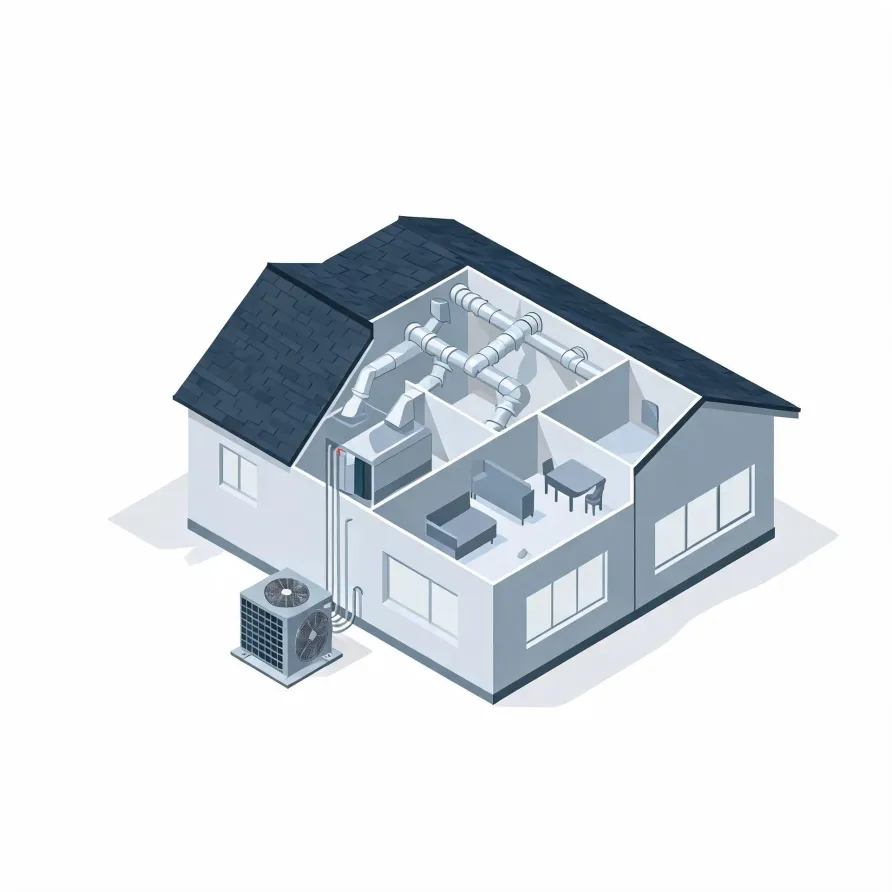
The outdoor condenser unit sits on a pad outside the house and holds the compressor, the condenser coil, and the fan that pushes heat out. These are the pieces a contractor reaches first when the system stops cooling, because a failed compressor or a fouled coil will shut down the whole system.
Inside the house, the air handler or furnace cabinet holds the evaporator coil and the blower fan, usually in a basement, closet, or utility room. The refrigerant lines that connect the two units and the expansion valve that controls refrigerant flow between them are also on the contractor's checklist, since a leak or a blockage in either one will show up as poor cooling even when the major components are intact.
The drawing shows a typical central AC layout, and a licensed contractor determines which components apply and what condition they are in for your specific home.
Get matched in Clarke CountyClarke County by the numbers
104 severe weather events were recorded in Clarke County, Iowa between 2015 and 2024.
NOAA National Centers for Environmental Information, Storm Events Database, bulk CSV export, events 2015-01-01 through 2024-12-31.Half the homes in Clarke County, Iowa were built in 1975 or earlier (2020-2024 ACS 5-year).
U.S. Census Bureau, 2020-2024 American Community Survey 5-Year EstimatesClarke County, Iowa holds 4,522 housing units (2020-2024 ACS 5-year).
U.S. Census Bureau, 2020-2024 American Community Survey 5-Year EstimatesOwners occupy 72.3% of the occupied homes in Clarke County, Iowa (2020-2024 ACS 5-year).
U.S. Census Bureau, 2020-2024 American Community Survey 5-Year EstimatesRules & Standards Behind Central AC Repair in Clarke County, Iowa9 sourced rules and standards
What Happens When the Contractor Comes Out
Split-system central air conditioners rated below 45,000 Btu/h manufactured on or after January 1, 2023 must meet a federal minimum of 13.4 SEER2.
Split-system central air conditioners rated at or above 45,000 Btu/h manufactured on or after January 1, 2023 must meet a federal minimum of 13.4 SEER2.
Split-system central air conditioners manufactured between January 1, 2015 and December 31, 2022 had to meet 13 SEER, the metric that preceded SEER2.
Single-package central air conditioners manufactured on or after January 1, 2023 must meet a federal minimum of 13.4 SEER2.
Space-constrained central air conditioners manufactured on or after January 1, 2023 must meet a federal minimum of 11.7 SEER2.
Federal efficiency standards for split-system central air conditioners and heat pumps are set on each certified combination of outdoor unit and indoor coil rather than on the outdoor unit alone.
Residential and light commercial air conditioning and heat pump systems assembled in the field, including mini-splits and unitary systems, may not be installed on or after January 1, 2025 using a refrigerant with a global warming potential above 700.
A field-assembled system whose specified components were all manufactured or imported before January 1, 2025 carries no installation compliance date under the refrigerant restrictions and may still be installed.
Licensing Rules for HVAC Repair in Clarke County, Iowa
Iowa requires a state licence to install or repair HVAC, refrigeration, mechanical or plumbing systems, and to operate as a contractor, with exceptions listed in section 105.11.
Severe Weather Events in Clarke County
Hard weather puts real hours on HVAC equipment. Stress that builds up over time is what drives repair calls, and that pattern is specific to what the sky does in this part of Iowa.
104 severe weather events, 2015–2024. Source: NOAA National Centers for Environmental Information, Storm Events Database.