Tell us about the job
Takes about a minute. No obligation.
A contractor working a central AC repair in this county has to decide whether a failing part wore out on its own schedule or under added load before they can say what the fix actually is. 141 severe weather events were recorded in Pottawattamie County, Iowa between 2015 and 2024. That puts compressor condition, capacitor fatigue, and refrigerant-side stress early on the diagnostic list, because severe weather is a standing part of how systems here have been running, not an edge case. A quote that skips that step can miss the reason the part failed, which changes what gets replaced.
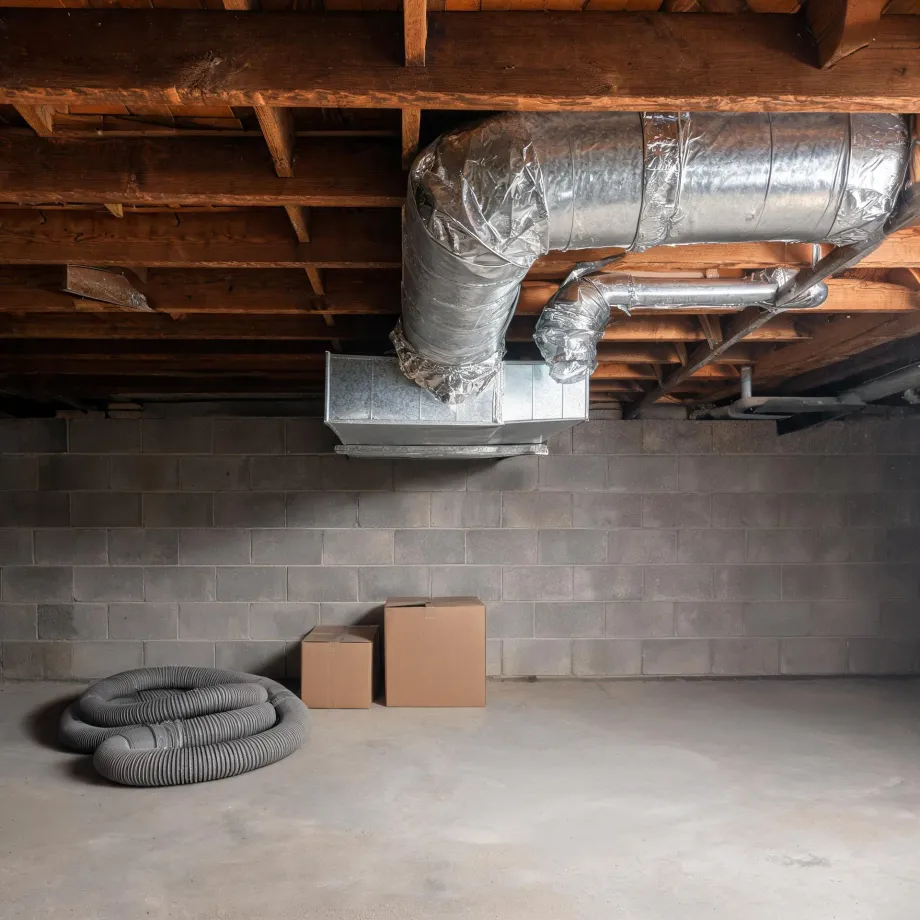
Ductwork in a house built for an earlier generation of equipment carries a long service history by the time a contractor opens it for a repair call. Half the homes in Pottawattamie County, Iowa were built in 1967 or earlier (2020-2024 ACS 5-year). That span means seals, joints, and flex sections have cycled through a great many Iowa summers and winters, and what a contractor finds inside the system often includes degradation that predates the current equipment by years. A refrigerant leak or a failed capacitor is straightforward; duct condition that has been compounding quietly is a different scope, and it shapes what the repair actually costs.
The Parts of a Central AC a Contractor Checks First
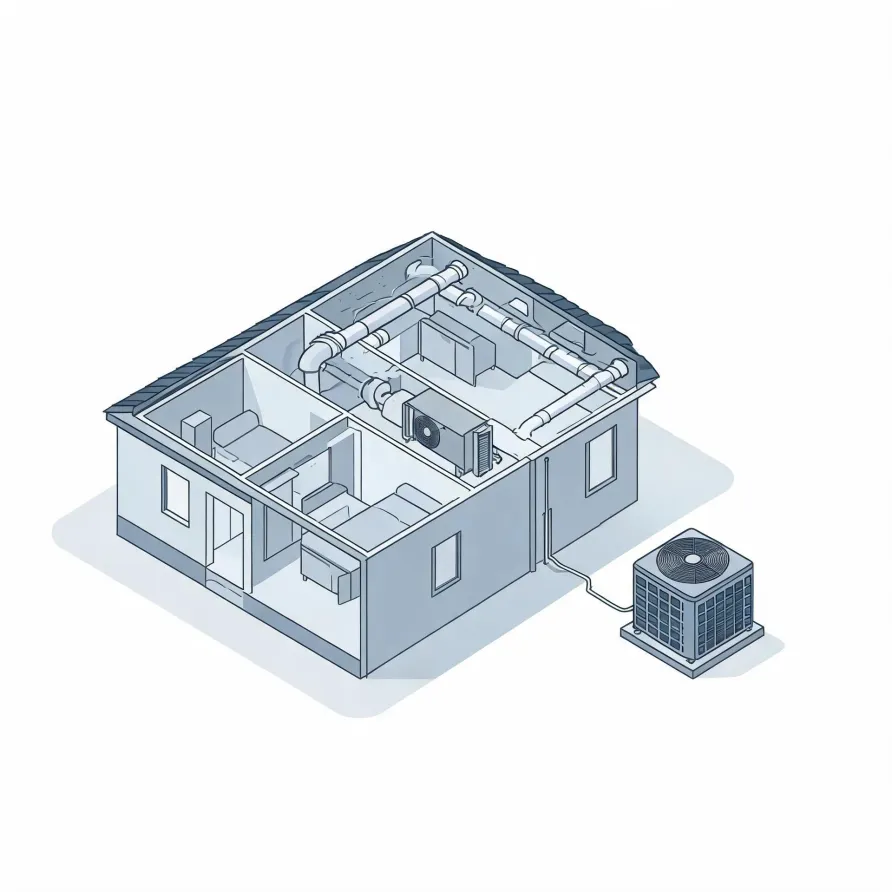
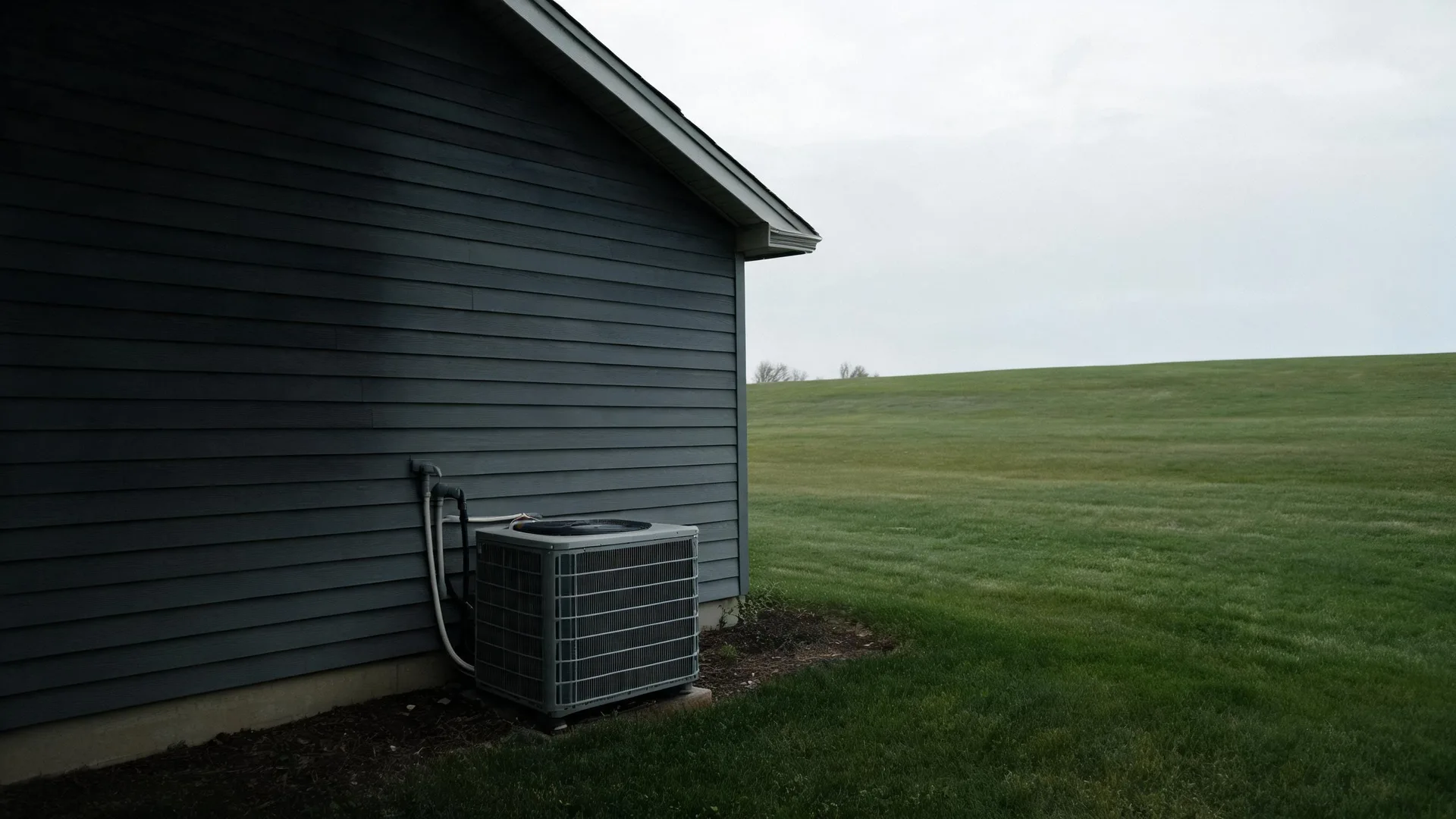
The outdoor condenser unit sits outside the house, usually on a concrete pad along a wall, and it carries the compressor and the condenser coil. Both are common starting points when a system stops cooling. The air handler or furnace sits inside, often in a utility closet, basement, or attic, and it holds the evaporator coil, which is another frequent source of trouble.
The refrigerant lines run between the two units, and a contractor checks them for leaks or damage alongside the electrical connections at both ends. The thermostat on the interior wall is smaller but gets looked at early, since a wiring fault or a failed sensor there can mimic problems that appear to be coming from much deeper in the system.
The drawing shows the typical layout of a central AC system, and a licensed contractor determines which components apply and need attention in your specific home.
Get matched in Pottawattamie CountyPottawattamie County by the Numbers
141 severe weather events were recorded in Pottawattamie County, Iowa between 2015 and 2024.
NOAA National Centers for Environmental Information, Storm Events Database, bulk CSV export, events 2015-01-01 through 2024-12-31.Half the homes in Pottawattamie County, Iowa were built in 1967 or earlier (2020-2024 ACS 5-year).
U.S. Census Bureau, 2020-2024 American Community Survey 5-Year EstimatesPottawattamie County, Iowa holds 40,083 housing units (2020-2024 ACS 5-year).
U.S. Census Bureau, 2020-2024 American Community Survey 5-Year EstimatesOwners occupy 69.9% of the occupied homes in Pottawattamie County, Iowa (2020-2024 ACS 5-year).
U.S. Census Bureau, 2020-2024 American Community Survey 5-Year EstimatesCodes & Standards Governing Central AC Repair in Pottawattamie County, Iowa9 sourced rules and standards
What the repair visit looks like
Split-system central air conditioners rated below 45,000 Btu/h manufactured on or after January 1, 2023 must meet a federal minimum of 13.4 SEER2.
Split-system central air conditioners rated at or above 45,000 Btu/h manufactured on or after January 1, 2023 must meet a federal minimum of 13.4 SEER2.
Split-system central air conditioners manufactured between January 1, 2015 and December 31, 2022 had to meet 13 SEER, the metric that preceded SEER2.
Single-package central air conditioners manufactured on or after January 1, 2023 must meet a federal minimum of 13.4 SEER2.
Space-constrained central air conditioners manufactured on or after January 1, 2023 must meet a federal minimum of 11.7 SEER2.
Federal efficiency standards for split-system central air conditioners and heat pumps are set on each certified combination of outdoor unit and indoor coil rather than on the outdoor unit alone.
Residential and light commercial air conditioning and heat pump systems assembled in the field, including mini-splits and unitary systems, may not be installed on or after January 1, 2025 using a refrigerant with a global warming potential above 700.
A field-assembled system whose specified components were all manufactured or imported before January 1, 2025 carries no installation compliance date under the refrigerant restrictions and may still be installed.
Licensing Rules for HVAC Repair in Pottawattamie County, Iowa
Iowa requires a state licence to install or repair HVAC, refrigeration, mechanical or plumbing systems, and to operate as a contractor, with exceptions listed in section 105.11.
Severe Weather Events in Pottawattamie County
Weather puts hours on HVAC equipment. The more a system is pushed to respond to temperature swings and storm recovery, the more it wears, and that wear is what eventually brings a repair call.
141 severe weather events, 2015–2024. Source: NOAA National Centers for Environmental Information, Storm Events Database.